

A community dedicated to gathering, nurturing, learning and building.
Downtown St. Louis
Chestnut Valley
now Enterprise Center area
Open to public / Not Open to public
Not open to public - DISPLACED

Chestnut Valley was a vibrant African American neighborhood in downtown St. Louis, centered around Market Street, Targee Street (now part of Chestnut Street), and Jefferson Avenue. Flourishing from the late 19th century into the early 20th century, it was a hub for Black culture, entertainment, and commerce during an era of racial segregation.
The district was home to numerous saloons, gambling houses, and brothels, many of which featured live music. Notably, Tom Turpin's Rosebud Café, operating from 1900 to 1906, was a significant venue for ragtime music, attracting musicians like Scott Hayden, Arthur Marshall, Joe Jordan, and Louis Chauvin. Scott Joplin, the renowned composer of ragtime music, also lived in St. Louis during this period and associated with musicians in the Chestnut Valley area.
Despite its cultural significance, Chestnut Valley faced challenges, including overcrowding and deteriorating conditions. In the 1950s, the area was demolished as part of urban renewal efforts, leading to the loss of this historic neighborhood. Today, the site is occupied by the Enterprise Center (formerly the Scottrade Center), home to the St. Louis Blues hockey team.
From Larry Melton, founder of the Scott Joplin Ragtime Festival in 1974 and the Sedalia Ragtime Archive in 1976. "That district loosely described was from Market Street on the South to Morgan on the north, Jefferson on the west and roughly around Tucker on the East. It was part of larger African American districts or ones nearby variously known as Death Valley, Mill Valley, and The Ville. It was where ragtime flourished briefly before World War I. Biographers have thoroughly documented the lives of Eliot and Joplin. The period Joplin and Eliot lived in close proximity only occurred during a brief window of time (1901-1903) but the details of the two men’s lives give me a lot to ponder. Now in all fairness, I have to imagine others have made this connection and I know others have come close. However, after connecting the dots to this new realization, I suddenly imagined a poignant scenario:
A young teen-ager bounds onto a city streetcar one day in 1903, pays his fare and takes a seat behind the Operator. No other passengers are coming so before the Conductor engages the power, he glances in his rear-view mirror to be sure his passengers are properly seated, There are only two in the car that morning. The Operator sees a boyish face immediately behind him and then across the chasm of empty seats, a dignified fellow sits in sad humiliation in the far back seat. With a sudden jerk the streetcar begins to move. These three strangers have ridden together often. The Operator knows the boy will get off near his school and the man in the back will depart at Union Station. Few conveyances would transport such combined genius as that dusty, dented old streetcar that early 20th century day. But for only a moment, like a camera, the rearview mirror might have captured the face of a future Nobel Poet Laureate and an image of one of the great seminal American classical music composers this country would eventually celebrate posthumously. Both of these men lived less than two hundred fifty yards from each other, but in 1903 St. Louis, they would have been separated by a wide racial divide.
For the brief time Scott Joplin lived at what is now 2658 Delmar, he was only two short city blocks from the Eliot home at 2635 Locust. The Eliots had remained at that location, because T.S. Eliot’s distinguished grandfather, William Greenleaf Eliot, founder of Washington University in St. Louis, had owned the property. The neighborhood was experiencing a serious decline, as described in Dr. Frances Dickey’s article “T.S. Eliot and the Color Line In St. Louis” (March 2021 Modernism/Modernity) Thus, we find this man and this boy, probably unknown to each other, living in close proximity. Given Eliot’s known passion for novelty music and the English Music Hall, we can only speculate about what might have happened had they met."
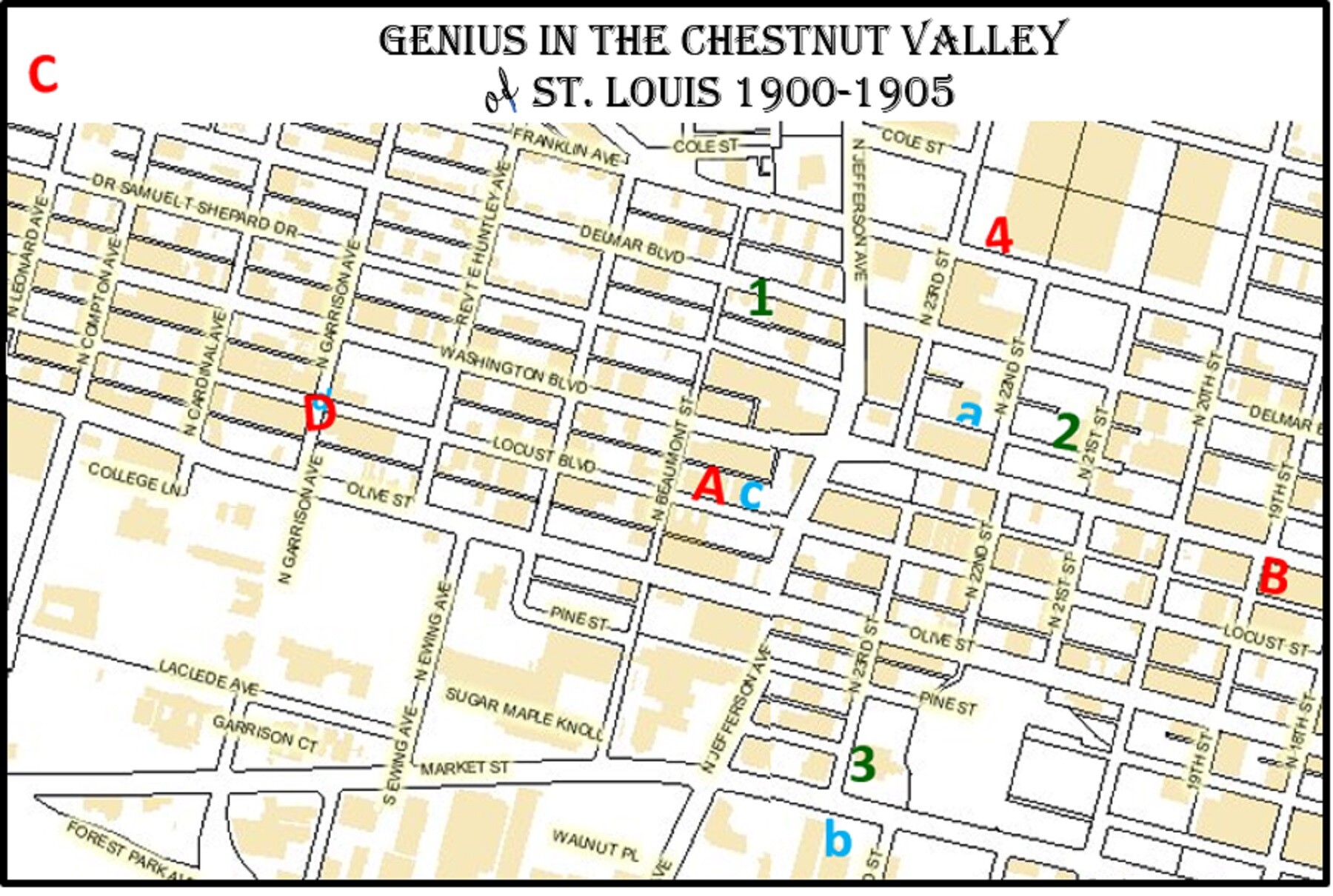
KEY TO MAP IN GALLERY
Ragtime related locations thanks to Dr. Edward Berlin’s book, King of Ragtime: Scott Joplin and His Era, Oxford, 2nd ed. 2016, p. 112,
Scot Joplin Related Sites
1 Joplin Residence – 1901-2 (Originally 2658A Morgan
is now 2658 Delmar) The Scott Joplin Historic Site
2. Joplin Residence – 1902 (2117 Lucas)
3. Joplin Residence – 1905-07 (2221 Market)
Ragtime Related Sites
a. Betty Ray’s – establishment. (1910) 2233 Lucas
b. Tom Turpin’s – Rosebud Café 2220-2221 Market (1903)
c. Betty Ray’s – establishment – 2652 Locust (1906-7)
d. Sam Patterson – (2215 Morgan) Joplin’s close friend
T.S. Eliot Related Sites
A. Eliot Home – 2635 Locust (to 1905) Vacant lot today
B. Smith Academy – where T.S.E. attended through high school
19th Street and Washington (1898-1905)
C, The Lockwood School – 3841 Delmar T.S.E. attended
grade school and Nanny Annie Dunne walked him
to and from school.
D. Unitarian Church of the Messiah – Locust and Garrison
where the Eliot’s attended
SOURCE: The historical information presented on this page is adapted with permission from Discovering African American St. Louis: A Guide to Historic Sites by Dr. John A. Wright, Sr. We are honored to share his invaluable research and historical insights, made available through the generous consent of Dr. Wright and the Missouri Historical Society Press. Their dedication to preserving and celebrating the rich legacy of Black St. Louis is a gift to our community—a testament to those who came before us and a guide for those who walk the path forward.

COMMUNITY CONTACT
No affiliations
now Enterprise Center area
OTHER SOURCES
ADDITIONAL RESOURCES COMING SOON!

For those interested in exploring this history further, the Missouri History Museum and the Washington University Bernard Becker Medical Library Archives house photographs and documents related to Chestnut Valley. Additionally, the Library of Congress provides historical maps and images of the area.