
A community dedicated to gathering, nurturing, learning and building.
The Ville, Northside, Riverview
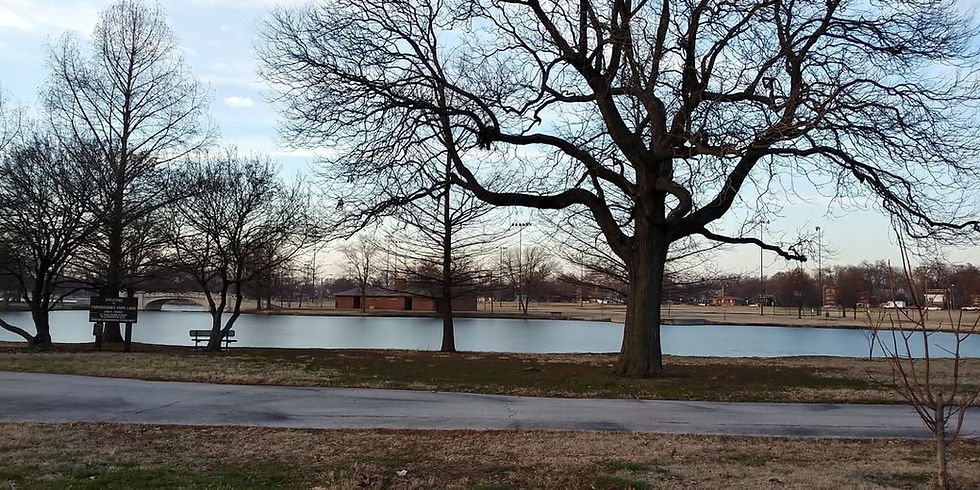
Fairground Park
Vandeventer and Natural Bridge
Open to public / Not Open to public
Open to public

Benton Barracks ("Camp Benton") was established in August 1861 at Fairground Park (Vandeventer & Natural Bridge) and prepared thousands of Federal troops from the Midwestern states for active service. The facility could accommodate up to 30,000 recruits and hospital patients at a time.
Lieutenant Richard Baxter Foster (1826-1901) led the men of the 62nd and held this educational opportunity in high regard. The abolitionists, teacher and later pastor volunteered to command the 62nd regiment and worked diligently to foster comraderie among his black enlisted men and white officers.
The 62nd (USCT) U.S.Colored Troops had one privilege never before offered to black soldiers mustered in at Benton Barracks: the opportunity for education. Arguing that an educated man made a better solider, the Western Sanitary Commission, a philanthropic organization, held classes in reading and writing for black soldiers while they underwent training at the Barracks. These lessons continued in various regiments throughout the War and as a result some black soldiers became literate.
In January 1866, Lieutenant Foster and his comrades began to contemplate the civilian fate of the 62nd regiment. With no opportunity to continue this education in Missouri, the men of the 62nd sacrificially donated over $5,000 to establish a university. Foster agreed to take charge. Later, soldiers of the 65th U.S.C.T. added $1,379.50, bringing the total to over $6,000.00 given for the establishment of Lincoln Institute.
Although speedily accomplished, the establishment of Lincoln Institute was a struggle for Foster. By February 1866, a Board of Trustees formed and by June 1866, the Circuit Court of Cole County accepted the institution's Articles of Association. The real challenge came in where to hold classes for the school.
Foster originally planned to establish Lincoln Institute in St. Louis. In an attempt to negotiate with the Methodist Church in their proposed Central University, Foster agreed to donate the $6,000 if the school would start immediately and admit blacks. After this attempt failed, Foster moved his efforts to Jefferson City.
Once in Jefferson City, Foster encountered opposition from both the white and black communities. The Negro Methodist Church refused him because the teachers would be white, while the Methodist Church refused him because the pupils were black. Finally, the township permitted the use of an abandoned public schoolhouse deemed "unfit" for white children.
Foster describes his first encounter with the building. "The rains pour through the roof scarcely less than outside. I could throw a dog through the side in twenty places. There is no sign of a window, bench, desk, chair or table."
Yet in this two-room, dilapidated structure, situated on "Hobo Hill" (now Simonsen School), Lincoln Institute opened its doors on September 17, 1866. On that first day, Foster taught two students, Henry Brown and Cornelius Chappelle. Yet, word spread quickly and before long the rooms filled to capacity. By 1868, Lincoln Institute faced financial difficulties. Foster appealed to the Jefferson City Board of Education and was granted the right to charge out of state students $1.00 per month. In addition to personal contributions, (supposedly Jesse James donated money twice) several organizations began to assist the school's efforts.
The Western Sanitary Commission gave $2,000, the Refugee Freedmen's and Abandoned Land Fund gave $6,000 and the Freedmen's Bureau gave $2,000.
The Fairground Park riot occurred on June 21, 1949 after the city announced plans to integrate the swimming pool at Fairground Park—then the largest municipal pool in the country. When African American children arrived to swim, they were met by a hostile white mob that quickly grew to several hundred people. Violence erupted as white residents, some armed with bricks and clubs, attacked Black swimmers and bystanders. Police intervened, but instead of protecting the Black youth, they forcibly removed them from the pool and closed it temporarily. The event exposed deep racial tensions in St. Louis and highlighted the resistance to integration in public spaces. In response to the unrest, city officials shut down the pool rather than continue efforts to desegregate it. The riot remains a pivotal moment in the history of racial segregation and civil rights in St. Louis.
SOURCE: The historical information presented on this page is adapted with permission from Discovering African American St. Louis: A Guide to Historic Sites by Dr. John A. Wright, Sr. We are honored to share his invaluable research and historical insights, made available through the generous consent of Dr. Wright and the Missouri Historical Society Press. Their dedication to preserving and celebrating the rich legacy of Black St. Louis is a gift to our community—a testament to those who came before us and a guide for those who walk the path forward.

COMMUNITY CONTACT
No affiliations
Vandeventer and Natural Bridge
OTHER SOURCES
ADDITIONAL RESOURCES COMING SOON!