
A community dedicated to gathering, nurturing, learning and building.
Central Corridor: Mill Creek Valley & Midtown
Ballad of Frankie and Johnny
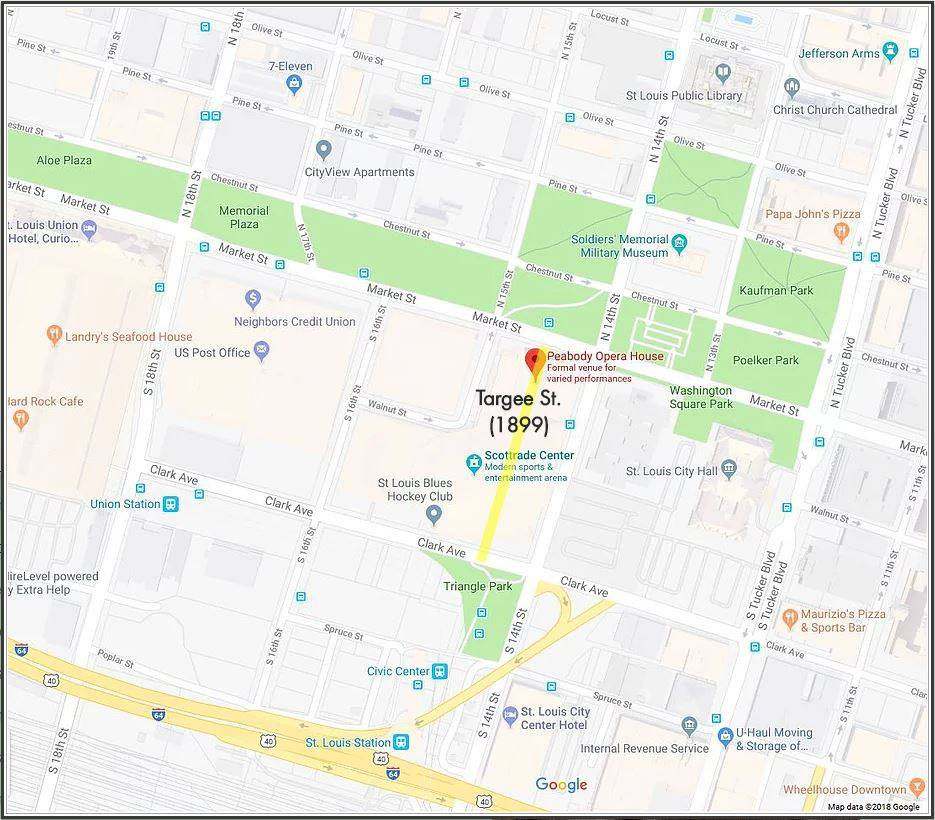
212 Targee Street (now Enterprise Center)
Open to public / Not Open to public
Not open to public - DISPLACED

According to Nathan B. Young (founder of St. Louis American) the song (and movie) "Frankie and Johnny" was written after New York producers came to a local club and heard musician Bill Dooley singing about Frankie Baker & Albert Britt. ("Frankie Killed Allen")
At 2:00 on the morning of October 15, 1899, Frankie Baker (1876 –1952), a 22-year-old woman, shot her 17-year-old lover and ragtime piano player, Allen ("Albert") Britt in the abdomen.
Britt had just returned from a cakewalk at a local dance hall (once located upstairs at Kram Fish Market near Biddle), where he and another woman, Nelly Bly (also known as "Alice Pryor"; no relation to the pioneering reporter Nellie Bly), had won a prize in a slow-dancing contest. Britt died of his wounds four days later at the City Hospital. [Wikipedia]
On trial, Baker claimed that Britt had attacked her with a knife and that she acted in self-defense:
On Oct. 15, 1899, Allen Britt stumbled up the back staircase of a rooming house at 212 Targee Street, burst into girl friend Frankie Baker's apartment, threw an oil lamp and pulled a knife. She grabbed a .32-caliber pistol from beneath her pillow and fired a fatal shot. [Tim O'Neil, STLToday]
Frankie was acquitted and freed. Two years later when the song went mainstream she left St. Louis due to the notoriety. When over 250 versions were being made including Hollywood movies, she sued Republic Pictures for defamation and anguish but was unsuccessful. She died in a Portland, Oregon, mental institution in 1952.
The night after the incident, Bill Dooley, a Black pianist and songwriter, composed the song that quickly became popular in many Black saloons, initially titled “Frankie and Albert.” Baker claimed self-defense and was ultimately acquitted of Britt’s murder. After her release, she left St. Louis, and the ballad followed her to Omaha, Nebraska, and eventually to Portland, Oregon.
Different styles and portrayals of the song have appeared in films and performances over the years, but the tragic real-life story of Frankie Baker remains at its core. Sadly, Frankie Baker died in a Portland mental institution in 1950.
SOURCE: The historical information presented on this page is adapted with permission from Discovering African American St. Louis: A Guide to Historic Sites by Dr. John A. Wright, Sr. We are honored to share his invaluable research and historical insights, made available through the generous consent of Dr. Wright and the Missouri Historical Society Press. Their dedication to preserving and celebrating the rich legacy of Black St. Louis is a gift to our community—a testament to those who came before us and a guide for those who walk the path forward.

COMMUNITY CONTACT
No affiliations
212 Targee Street (now Enterprise Center)
OTHER SOURCES
ADDITIONAL RESOURCES COMING SOON!