

A community dedicated to gathering, nurturing, learning and building.
Central Corridor: Mill Creek Valley & Midtown
Rosebud Cafe
2222 Market Street - Replica at 2658 Delmar Blvd
Open to public / Not Open to public
Not open to public - DISPLACED (see Scott Joplin House)
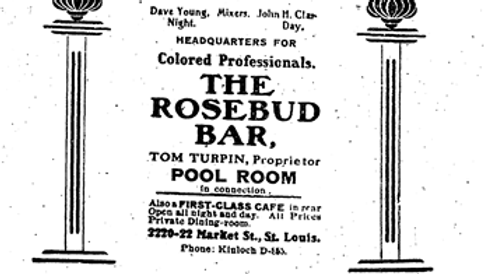
The original Rosebud Café, once located at 2220–2222 Market Street in downtown St. Louis, was one of the city’s most vibrant and influential African American entertainment venues in the early 20th century. Opening its doors in the early 1900s, the Rosebud quickly became known as a hotspot for ragtime music, a genre that was emerging as a uniquely American form of expression—and one that would later give rise to jazz and blues. The club stood just west of Jefferson Avenue in a bustling district filled with bars, theaters, and clubs that catered primarily to Black patrons during the era of segregation.
The Rosebud Café was more than just a music venue—it was a social and cultural nucleus for Black St. Louisans and a proving ground for some of the most influential musicians of the ragtime era. Most notably, the venue was closely associated with Scott Joplin, the "King of Ragtime," who had moved to St. Louis from Sedalia around 1900 and was already gaining national fame for compositions like Maple Leaf Rag. Though Joplin did not exclusively perform at the Rosebud, the venue was central to the ragtime scene that he helped define.
Owned and operated by Tom Turpin, a pioneering African American composer, bar owner, and publisher, the Rosebud Café offered a platform for countless musicians who shaped the sound and soul of the early 20th century. Turpin himself was the author of Harlem Rag (1897), considered the first published ragtime composition by an African American, and his role in fostering musical talent in St. Louis cannot be overstated. As one of the few Black business owners in the city at that time, Turpin’s Rosebud Café was a rare space where African American artists, writers, and thinkers could gather, perform, and thrive in an otherwise racially segregated and economically challenging environment.
The venue attracted other major figures in ragtime and early jazz, including James Scott, Joe Jordan, and Louis Chauvin—each of whom left a mark on the American musical landscape. The Rosebud was not only a place to hear live music but a site of collaboration, improvisation, and cultural creation that helped launch St. Louis onto the national stage as a hub for Black musical innovation.
Despite its popularity and importance, the original Rosebud Café was eventually closed and later demolished as downtown St. Louis was reshaped by urban renewal and highway construction projects in the mid-20th century. However, its legacy has not been forgotten.
Today, a recreation of the Rosebud Café—called the New Rosebud Café—has been installed as part of the Scott Joplin House State Historic Site, located at 2658 Delmar Boulevard, just north of downtown in the neighborhood where Joplin once lived. This restored historic site honors Joplin’s life and legacy, as well as the broader cultural history of ragtime and Black artistry in St. Louis. The New Rosebud Café includes period furnishings and interpretive exhibits, giving visitors a vivid sense of the atmosphere and importance of the original café. Guided tours offer insights into the lives of Joplin, Turpin, and their musical peers, as well as the challenges they faced navigating a segregated world.
The rebirth of the Rosebud Café within the Joplin House site serves as a powerful tribute to a place that helped shape American music and nurtured generations of Black artists. It stands today as a reminder of the resilience, brilliance, and creativity that defined St. Louis’s African American community at the turn of the century—and continues to inspire new generations.
SOURCE: The historical information presented on this page is adapted with permission from Discovering African American St. Louis: A Guide to Historic Sites by Dr. John A. Wright, Sr. We are honored to share his invaluable research and historical insights, made available through the generous consent of Dr. Wright and the Missouri Historical Society Press. Their dedication to preserving and celebrating the rich legacy of Black St. Louis is a gift to our community—a testament to those who came before us and a guide for those who walk the path forward.

COMMUNITY CONTACT
No affiliations
2222 Market Street - Replica at 2658 Delmar Blvd