
A community dedicated to gathering, nurturing, learning and building.
The Ville, Northside, Riverview
The Ville
The Ville
Open to public / Not Open to public
Open to public

During the mid-1800s, Charles Elleards, a horticulturist, built a two-story brick home on Goode Avenue (now Annie Malone Drive) and established a large nursery on his estate. The nursery stretched from Goode to Newstead Avenue, and from Old St. Charles Rock Road (later renamed Dr. Martin Luther King Jr. Drive) to Cote Brilliante Avenue.
A small town called Elleardsville grew up around the nursery. In 1876, it was annexed into the City of St. Louis. Over time, Elleardsville became known as The Ville. Initially home to German and Irish immigrants as well as some African American families, the area evolved into a vital center of Black life in St. Louis.
The Ville’s first Black institution was Elleardsville Colored School No. 8, opened in 1873, later renamed Simmons School. St. James African Methodist Episcopal Church was established in 1885.
At a time when much of St. Louis was governed by restrictive real estate covenants that prevented African Americans from owning or renting property in many areas, The Ville remained open to Black residents. Between 1920 and 1950, the Black population in The Ville grew from 8% to 95%, transforming it into a thriving Black neighborhood.
Now bounded by Dr. Martin Luther King Drive, Taylor Avenue, St. Louis Avenue, and Sarah Street, The Ville is remembered as the cultural and intellectual heart of St. Louis’s African American community. It was home to several key institutions, including:
Sumner High School
Turner School
Stowe Teachers College
Poro College
The Annie Malone Children’s Home
John Marshall Elementary School
St. Philip's Lutheran Church
Homer G. Phillips Hospital
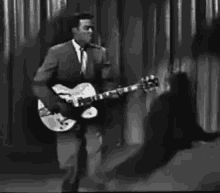
Top entertainers, such as Albert "Blues Boy" King and B.B. King, performed in local venues, including the Harlem Tap Room at 4131 Dr. Martin Luther King Drive. The Ville also produced many notable figures—activists, writers, educators, entertainers, and politicians—who contributed significantly to both local and national Black history.
SOURCE: The historical information presented on this page is adapted with permission from Discovering African American St. Louis: A Guide to Historic Sites by Dr. John A. Wright, Sr. We are honored to share his invaluable research and historical insights, made available through the generous consent of Dr. Wright and the Missouri Historical Society Press. Their dedication to preserving and celebrating the rich legacy of Black St. Louis is a gift to our community—a testament to those who came before us and a guide for those who walk the path forward.

COMMUNITY CONTACT
No affiliations

The Ville
OTHER SOURCES
ADDITIONAL RESOURCES COMING SOON!